 English (United Kingdom)




Horses came to China from Central Asia, Mongolia and Tibet.
In the ancient Yi Jing tradition, the horse is the “yin” to the dragon’s “yang”.
The god of war Guan Yu rode a horse with red hair, and this animal is associated with the power of metal and with the west.
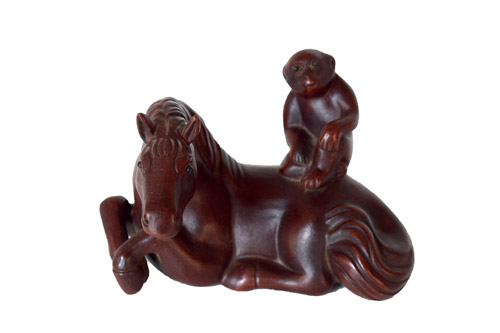
In the Tang and Mongol dynasties, which came from the north, horses were much admired animals, appearing in many works of art. One Tang emperor had a troupe of dancing horses for his entertainment. Travelling around China, small statues of horses with monkeys on their backs are to be found in great number.
The Chinese calendar features a series of animals, with the mounted monkey having a meaning all its own.
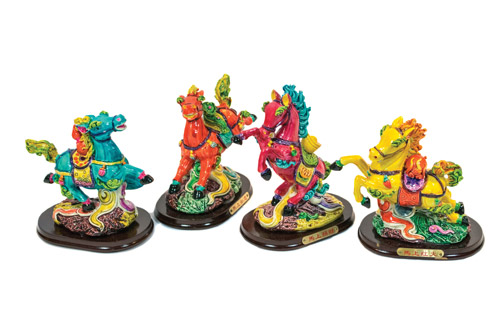
In Feng Shui, the horse (the seventh sign of the Chinese Zodiac) symbolizes nobility, perseverance, strength, loyalty, victory, power, freedom, speed and success.
It is believed that placing an image of a horse in a home or a workplace reinforces the positive characteristics of the people who live or work there.
The monkey (the ninth sign of the Chinese Zodiac) is known to be agile and playful, yet extremely intelligent and quickwitted.
It is believed that placing an image of a horse in a home or a workplace reinforces the positive characteristics of the people who live or work there.
The monkey (the ninth sign of the Chinese Zodiac) is known to be agile and playful, yet extremely intelligent and quickwitted.
All of which make the monkey and the horse a potent combination when it comes to promoting success in business.
In Chinese, a monkey sitting on a horse is written,“Ma Shang Feng Hou”, which translates into “success is fast approaching”. And when the monkey is holding a peach, it draws positive vibrations for good health, longevity, even immortality.
In Chinese, a monkey sitting on a horse is written,“Ma Shang Feng Hou”, which translates into “success is fast approaching”. And when the monkey is holding a peach, it draws positive vibrations for good health, longevity, even immortality.


